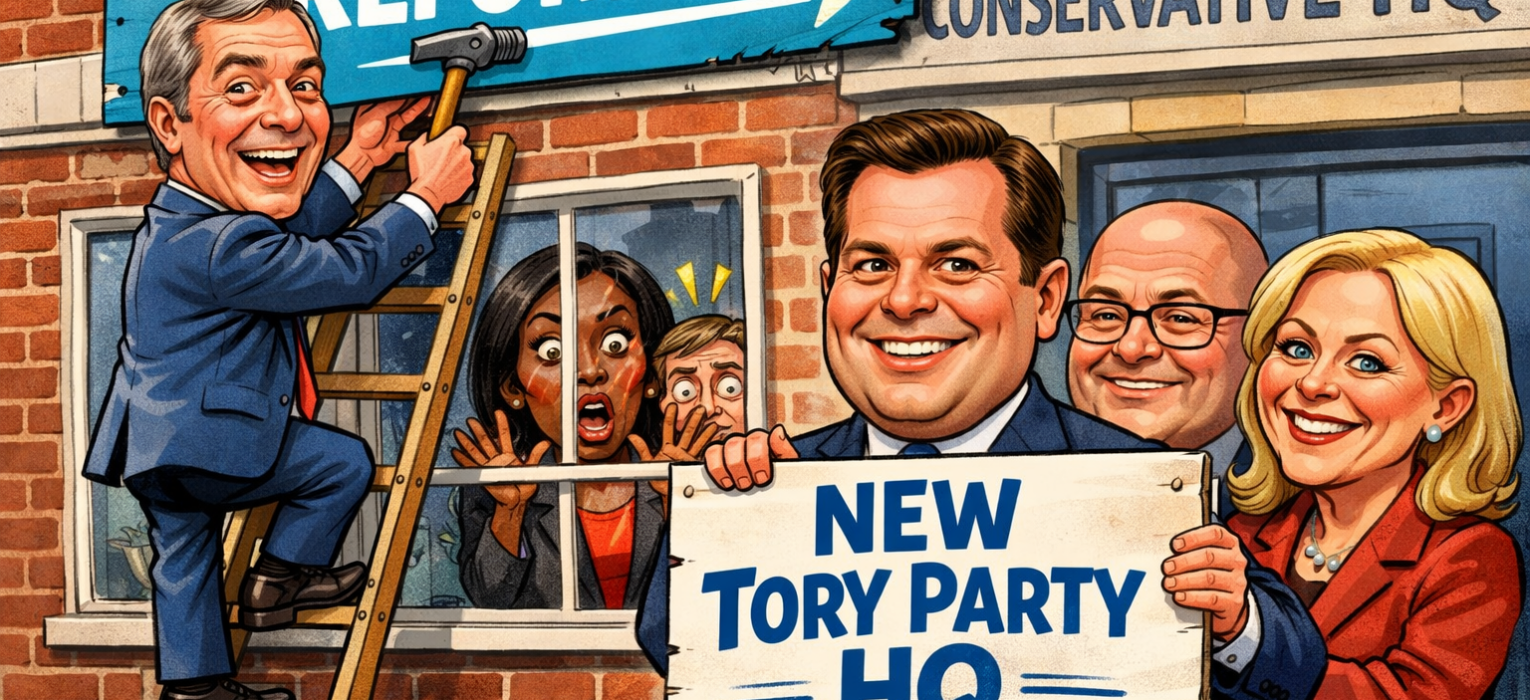
British politics has officially entered “hold my pint and watch this” territory. Robert Jenrick — former Conservative MP, ex-Housing Secretary, leadership hopeful, and recent enthusiast of talking to the nation via short-form video — has defected to Nigel Farage’s Reform UK.
Yes. That Robert Jenrick. The one who spent years polishing the Conservative brand, running for the top job, and explaining policy while staring intensely down the camera like a man who’s just discovered TikTok has an algorithm.
This isn’t just a political move. It’s a vibe shift.
From Cabinet Table to Camera Phone
Before the defection, Jenrick had already become something of a Westminster curiosity. While most MPs were still treating social media like a suspicious microwave from the 1990s, Jenrick leaned in — hard.
Cue:
- Direct-to-camera monologues
- Carefully framed backdrops
- A tone that said “I’m serious, but also relatable, please clap”
It was easy to laugh. Politicians doing TikTok always is. But behind the ring light and earnest delivery was something more deliberate: a politician trying to bypass the party machine and speak directly to voters.
That matters — because it’s exactly the same route Nigel Farage has been taking for years.
A Defection Made for Headlines
Then came the moment Westminster loves best: the dramatic exit.
- Frontbench sacked, whip removed: Kemi Badenoch said she had “irrefutable evidence” that Jenrick was planning to jump ship.
- Immediate Reform UK appearance: Within hours, Jenrick was standing next to Farage, declaring the Conservatives “a failed party” and backing Reform as the future.
- Media meltdown: Newspapers, radio shows, WhatsApp groups, and pub tables all lit up with the same questions — Who’s next? How bad is this? And is this the start of something bigger?
It was high drama in Westminster.
It was high comedy everywhere else.
Robert Jenrick: Not a Nobody, Not a Accident
This is what makes the defection sting.
Jenrick isn’t a random backbencher having a wobble. He’s been central to the modern Conservative story:
- MP for Newark since 2014
- Housing Secretary from 2019–2021, often in the thick of controversy
- Leadership contender in 2024, serious enough to be taken seriously — but not serious enough to win
- Media-savvy moderniser, keen to project competence, control, and clarity
Add to that his increased public visibility — including a noticeable push to speak directly to voters — and you get a politician who clearly believed he still had a national role to play.
Just not, apparently, in the Conservative Party anymore.
Was This About Losing the Leadership?
Let’s address the obvious question — the one everyone is thinking but pretending not to say out loud.
Did losing the leadership contest help push him out the door?
Probably not on its own. But it’s hard to ignore the pattern: a politician who aimed for the top, missed, then found himself increasingly out of sync with the party’s direction.
That doesn’t make the move petty. It makes it human.
Politics, like football management, rarely rewards patience after you’ve been passed over.
Why This All Feels Weirdly Inevitable
The reaction to Jenrick’s defection wasn’t mass shock. It was more of a collective nod.
“Oh. Right. That makes sense.”
Why? Because Jenrick has long represented a strand of Conservatism that feels:
- The party lost its edge
- Leadership became managerial rather than directional
- Voters want something clearer, louder, and less filtered
Meanwhile, Reform UK has been standing just outside the Tory house, ringing the doorbell repeatedly and shouting, “We’re still here, by the way.”
Jenrick didn’t so much defect as complete a journey.
Farage’s Long Game (Again)
Nigel Farage doesn’t need to take over the Conservative Party.
He never has.
- UKIP didn’t merge — it forced Brexit
- Reform UK doesn’t need a rebrand — it just needs momentum
By welcoming Jenrick, Farage gets something invaluable: proof that serious Conservative figures are willing to walk.
That’s not just symbolism. That’s strategy.
Why It’s Both Funny and Serious
Let’s be honest — there is something funny about a former cabinet minister perfecting TikTok delivery before joining Nigel Farage.
But there’s also something serious underneath the satire.
This is about:
- The breakdown of party loyalty
- The rise of personality-led politics
- A Conservative Party struggling to hold its own coalition together
Laugh at the delivery if you want — the message clearly mattered to him.
The bigger story?
So many people were already expecting it.
Nigel Farage doesn’t need to create a new Conservative Party.
He just stands there with a ladder, changing the sign, while the old one argues inside about who left the window open.